
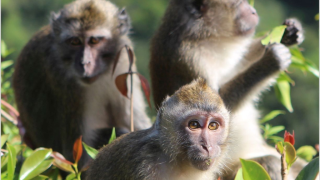
We call for funding and provision of lifetime care
We are calling on the U.S. Congress to fund care for the estimated 200 primates who will no longer be used in research following the news that the U.S. Centers for Disease Control and Prevention (CDC) will phase-out its use of monkeys.
We also want to see permanent sanctuary placements for all non-human primates who are released from federally funded research.
Currently, monkeys can die during scientific experiments or be deliberately killed so that their tissues and organs can be analyzed. A full transition away from the use of animals in science is the goal Cruelty Free International has long been pushing for. Lasting progress made towards that goal is the right direction of travel, and it follows that as progress is made, animal testing and breeding facilities would be successively wound down.
We have long called for an end to the use of primates in research, and for their replacement with humane, non-animal testing methods. Yet what happens to these animals when research ends must not be overlooked.
Whenever a facility is to close, there cannot be uncertainty over the lives or future safety of the animals once they are no longer available for use by researchers.
The argument for publicly funded lifetime care of primates no longer used in research is not new. In 1997, the Institute for Laboratory Animal Research said that the government has a 'moral responsibility' to provide long-term care for chimpanzees used in research, a finding that helped lead to the CHIMP Act of 2000.
This law created a federally supported sanctuary system, prohibited killing chimpanzees simply because they were no longer useful to researchers, and required the government to cover most of the costs of establishing and maintaining their lifelong care. Subsequent NIH decisions – culminating in the 2013 “retirement” of more than 300 federally owned chimpanzees – reinforced this commitment.
The U.S. is one of the world’s top users of monkeys for experiments, with 104,808 non-human primates held or used in laboratories in 2024. Of these, 1,232 were used in 'Category E' experiments, which cause the most physical pain and have no pain relief provided. Many of these animals are born at large government-funded captive primate breeding centers in the U.S., while others are imported from abroad, sourced from commercial breeding facilities or captured directly from the wild. Our investigations in Southeast Asia and Mauritius have exposed the undeniable brutality and misery inflicted on monkeys from the moment they’re caught, all the way through the supply chain, ending in a laboratory cage or breeding farm.
In 2016, we organized an open letter signed by 21 experts, including renowned naturalist Sir David Attenborough and the late Dr. Jane Goodall, raising serious concerns about the use of primates in research and calling for an end to cruel neuroscience experiments.
Sir David Attenborough said in 2016, “The recognition that apes, certainly, and to an extent other primates, are so akin to ourselves, and can suffer so much, as we can, has transformed our attitude, or should have transformed our attitude, to using them for our own benefit. They are sentient beings that have mental lives comparable to ours, and sensitivities, and pain and deprivation mean things to them, just as they mean things to us.”
Dr. Jane Goodall added, “I and my team have studied chimpanzees, our closest living relatives, for over 50 years. I can state categorically that they have a similar capacity for suffering, both mental and physical, and show similar emotions to many of ours. We also study baboons and other monkeys and there is no doubt they too can suffer and experience fear, depression, anxiety, frustration and so on. To confine these primate relatives of ours to laboratory cages and subject them to experiments that are often distressing and painful is, in my opinion, morally wrong.”
Our Head of Public Affairs North America, Monica Engebretson, said, “We have already seen that the federal government can and should provide for their future when primates are no longer used in research. The same moral responsibility that led to the provision of care for chimpanzees should now be extended to all primates used in U.S. laboratories.
“The broader discussion over the use of primates in science may take years to resolve, but there is a clear and immediate step we can take now: ensuring that primates used in taxpayer funded research are given the chance for peaceful post-research lives. Providing these opportunities is the right thing to do and delivers an immediate, tangible change to individual animals’ lives.”